


How we made this guide: picks and specs come from our catalog and fitment data, owner quotes come from verified reviews and the guide was drafted with AI help, then checked and edited by Trevor Hall.
A little, at steady highway speed, on some trucks. A tonneau cover can smooth the air over the bed, but the gain is small and often too small to see on a fuel log. A cover that sags or flaps can even cost you mileage.
If fuel is part of the reason you are buying, pick a flat, rigid cover that sits level with the rails, such as the BAKFlip MX4 from $1,199.99. On a budget, the Extang Trifecta 2.0 from $469.99 is a light soft folder that stays flat if you keep it tensioned. Treat any saving as a bonus on top of a drier, more secure bed. Leave the tailgate up.
Quick answer
- Do tonneau covers save gas? Sometimes, a little, mostly above 50 mph. Most owner reports on the covers we carry run from a loss to about 3 mpg, with one outlier claiming 30%.
- Which cover helps most? A flat, taut, low one. Hard covers stay flat at speed. Soft covers do if tensioned well.
- Tailgate up or down? Up. A pickup with the tailgate down used more fuel when the MythBusters measured it.
- Will it pay for itself? Rarely on fuel alone.
What happens to the air over an open bed
Air leaves the cab roof, drops toward the bed and meets the tailgate. With the tailgate up, a slow, swirling pocket of air settles in the bed. That trapped vortex acts like a soft lid, so the main flow skips over the bed.
So the bed is already partly "covered" by its own air. A tonneau cover swaps that pocket for a flat surface, which cleans up the flow a little on some trucks and barely changes it on others.
Speed decides how much it matters. Aerodynamic drag grows with the square of speed, so it barely registers in town. The U.S. government site fueleconomy.gov notes that gas mileage usually decreases rapidly above 50 mph.

What the tests and owners actually found
Controlled tests are rare, and the numbers in ads seldom come with a method. Here is what holds up.
Tested: the tailgate matters
In 2005 the MythBusters drove two identical pickups, one with the tailgate up and one with it down. The truck with the tailgate down used fuel faster. The closed tailgate holds a locked vortex in the bed. Drop it and the vortex breaks up and drag rises.
In a 2006 revisit with a calibrated fuel flow gauge, they confirmed it and tried a hard top, a mesh tailgate and no tailgate. The mesh tailgate was the most efficient setup they tested. The lesson: small shape changes behind the cab move fuel use a little either way, and a lid is not automatically the winner.
Tested: the wind tunnel
In a 1988 SAE technical paper, Texas Tech engineers tested add-on parts for pickups on scale models and a full-size truck in wind tunnels. A cover over the rear part of the bed cut drag by 5% to 6%. That was a partial cover over the back of the bed, not a full tonneau. The figure is drag, not fuel. The two are not the same thing.
Why a drag cut is not an mpg gain
A 5% cut in drag does not mean 5% more mpg. Tires, drivetrain losses, hills and acceleration take the rest of the engine's effort. Their share is largest in town.
Fueleconomy.gov shows the scale with cargo boxes. A large, blunt roof box can cut fuel economy by 6% to 17% on the highway. A rear-mount box, which sits in the wake behind the vehicle much like a bed, costs only 1% to 5%. A tonneau cover adds no frontal area at all, so expect its effect to be smaller again.
Reported: what owners said
Of the 3,291 owner reviews we checked for the covers we carry, 35 mention fuel. Nine put a number on the gain, from 0.2 mpg to 3 mpg. Six of those nine are hard folding covers. Two say the cover did nothing or made it worse. One owner claimed 30% from a dash readout on one flat interstate run, which says more about flat roads than the cover.
“I had never owned a truck bed cover. This Installed easily on my 2017 F150. Gas miliage improved by 0.2mpg since installing.”
BAKFlip G2 owner · 5 out of 5 stars
“The only drawback is there is a large gap between bows so when it is windy the fabric caves in between the bows and acts like a wind brake. Fuel mileage suffers because of this.”
Extang Trifecta ALX owner · 4 out of 5 stars
Treat these as reports, not results. Owners who see a gain are more likely to mention it. Still, the spread fits the physics: small gains are common, big ones rare and a loose cover can go backward.
Tailgate up or down: the myth that will not die
Keep the tailgate up. Dropping it breaks up the air pocket that lets the flow skip over the bed, so drag goes up, not down. With a cover fitted, an open tailgate just lets road spray in.
It depends on your cover type
We found no public test of every style on the same truck, so the table rates each type on what drives the result: shape at speed and relative weight.
| Cover type | Shape at speed | Weight | Likely mpg effect | From |
|---|---|---|---|---|
| Hard folding | Rigid panels, flat and low | Medium | Small gain possible; most owner reports | $899.99 |
| Hard roll-up | Aluminum slats, flat and low | Medium | Small gain possible | $1,199.99 |
| Retractable | Flat deck, canister at the cab end | Heavy | Small gain possible | $1,191.19 |
| Soft folding | Vinyl on bows; can dip between them | Light | Small gain if taut; can go negative if it sags | $339.99 |
| Soft roll-up | Vinyl on bows with tension adjusters | Lightest | Small gain if taut; can flutter if loose | $349.99 |
| One-piece | Smooth single lid, often paint-matched | Heavy | Small; shape varies by model | $1,299.99 |
A latched hard cover keeps its shape at highway speed. Its cost is weight, but fueleconomy.gov puts an extra 100 pounds at about 1% of mpg, less on bigger vehicles.
A well-tensioned soft cover is nearly as flat and lighter. The risk is shape. Owners describe vinyl that flaps on the highway or caves in between bows, and a fluttering skin adds drag. Our guide to the types of truck bed cover compares every style.

Which tonneau cover improves gas mileage the most?
We found no test that ranks covers by mpg, so pick on shape: flat, low, rigid and sealed. These three suit owners who log a lot of highway miles. Browse every style in our tonneau covers range.
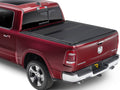
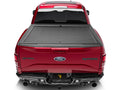
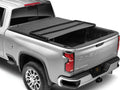
Flat and fast to open: BAKFlip MX4

Best hard folding
BAKFlip MX4 Hard Folding Tonneau Cover
From $1,199.99 · Daily drivers who want a flat, locked lid and full bed access.
Aluminum panels over a polymer core, EPDM seals and drain tubes. It sits low on the rails, rates 400 lb spread evenly and folds against the cab for 100% bed access. It clamps on in about 30 minutes. Its 5,025 owner reviews average 4.6.
“Not only does the MX4 look great, but it saves a few mpg's as a result of having less wind drag.”
BAKFlip MX4 owner · 5 out of 5 stars
Pros
- Rigid panels, no fabric to flap
- Auto latches lock with the tailgate
- Full bed access when folded
Cons
- Folded panels block part of the rear window
- Heavier than vinyl
- More than double the price of a soft cover
- Some owners report drips at the panel joints in heavy rain
Skip it if you want the rear window clear with the bed open; the Revolver X4s rolls up low at the bulkhead instead.

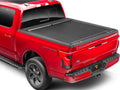
Flat and rolled out of the way: BAK Revolver X4s

Best hard roll-up
BAK Revolver X4s Hard Roll-Up Tonneau Cover
From $1,399.99 · Highway drivers who want a rigid, locked cover and a clear rear window when it is open.
Interlocking aluminum slats sit under a one-piece vinyl skin, and locking rails grip the cover along both sides. Owners report it stays flat and quiet at highway speed. It rates 400 lb spread evenly, rolls onto a low spool at the bulkhead for full bed access and clamps on in about an hour. BAK backs it for 5 years, and its 1,492 owner reviews average 4.6.
“There is zero rattle or noise from the cover at highway speeds or going over bumpy country roads, rolled up or fully extended.”
BAK Revolver X4s owner · 5 out of 5 stars
Pros
- Rigid slats, no fabric to flap
- Rolled up, the rear window stays clear
- 5-year warranty
Cons
- Costs more than the MX4
- Locks only when the tailgate does
- The rails need careful setup to latch along their full length
- Some owners report it stiffens or ices up in hard cold
Take care setting up the rails, and check the latches along the full length after the first week. One owner found a gap on the interstate:
“Thought everything was lined up and locked down, but after a week my kids noticed a section of the cover lifting up off the rail about 2-3 feet behind the cab when I was going down the interstate at 75mph. Evidently the little teeth on the cover were not going completely into the groove in the side rail on one side and locking down.”
BAK Revolver X4s owner · 5 out of 5 stars
The owner called it an easy fix: take the cover and side rails off and add shims. Skip it if your tailgate does not lock or you would rather pay the MX4's lower price. See the best roll-up tonneau covers for more.

Light and removable: Extang Trifecta 2.0

Best soft cover
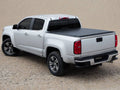
Extang Trifecta 2.0 Soft Folding Tonneau Cover
From $469.99 · Budget buyers who remove the cover often and keep it tensioned.
A soft folding vinyl cover on an aluminum frame with triple-fin seals and tool-free clamps. It opens two-thirds of the bed folded and lifts off for the rest. Installation takes under an hour. Extang backs it with a limited lifetime warranty, and 1,290 owner reviews average 4.7.
“Easy to install, looks good and does the intended job. The back stays dry and gas mileage is averaging about 1.2 miles per gallon better than before using the cover.”
Extang Trifecta 2.0 owner · 5 out of 5 stars

Pros
- Lightest of the three
- Lifts off in minutes
- Under $500 on most trucks
Cons
- Vinyl can be cut
- Some owners report flapping on the highway
- Two-thirds access unless removed
“How do you tighten the cover? It does flap going down the highway.”
Extang Trifecta 2.0 owner · 4 out of 5 stars
The same owner doubts it saved any fuel, which fits the physics: a skin that flaps adds drag.
Skip it if tools stay in the bed overnight: vinyl can be cut, and a hard cover over a locked tailgate is harder to get into. See the best hard folding tonneau covers.
How to get the most mpg from any cover
- Close it on the highway. Any gain depends on the flat, closed shape. Never drive a soft folder part way open: Extang says to run a Trifecta flat with every clamp on, or fully folded with the straps done up.
- Keep soft covers taut. Re-check tension as the seasons change. Vinyl tightens in cold and relaxes in heat.
- Check seals and clamps. A cover that lifts at the tailgate lets air and water under it. Our waterproof tonneau covers guide covers seal care.
- Remove what you are not using. Fueleconomy.gov advises taking off an external cargo box when it is not needed.
- Slow down. Above 50 mph, speed costs more fuel than any accessory saves.

How to measure your own mpg change
The dashboard average hides the change you want to see. Measure at the pump. On an electric truck, compare miles per kWh over the same routes instead.
- Fill to the first click and reset the trip meter.
- Drive a full tank of your normal routes, refill to the first click and divide miles by gallons.
- Repeat for two or three tanks. Then fit the cover and run the same tanks, routes and speeds.
Do both halves in the same season with the same load. A headwind, a cold snap or a trailer moves the number more than a cover will.
Then run the payback math. At 15,000 miles a year, going from 20 to 21 mpg saves about 36 gallons, roughly $110 a year at $3 a gallon. That repays a soft cover near $500 in about 5 years and a hard cover near $1,200 in about 11.
Frequently asked questions
Does a pickup get better gas mileage with the tailgate up or down?
Up. The closed tailgate holds a pocket of air that lets the flow pass over the bed. The MythBusters found a pickup used fuel faster with the tailgate down and confirmed it in a 2006 retest with a fuel flow gauge.
What can I do to make my truck get better gas mileage?
Slow down, since mileage falls quickly above 50 mph. Keep the tires at the pressure on the door sticker. Remove roof boxes, racks and cargo you are not using. A blunt roof box can cost 6% to 17% on the highway, far more than a cover wins back.
What is the difference between a truck bed cover and a camper shell?
A tonneau cover is a flat lid at bed-rail height. A camper shell, or cap, is a tall enclosure near cab height. It adds weight and height, and its fuel effect depends on its shape. See what a tonneau cover is.
What are the benefits of using a tonneau cover on a truck?
Dry cargo, cargo hidden behind a lock and light items that stay in the bed at speed. A small highway fuel gain is a bonus. Before an automatic wash, read our tonneau cover car wash guide.
Find a cover that fits your truck