
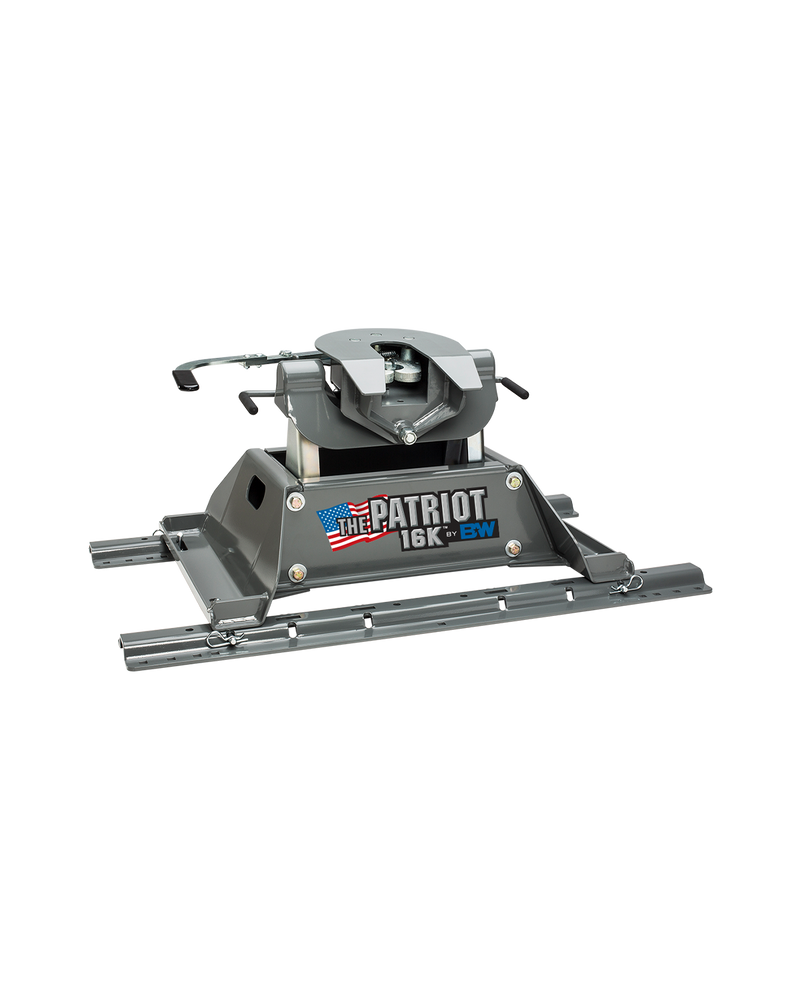
B&W Patriot 16K Rail-Mounted Fifth Wheel Hitch, 16,000 lb GTW, 4,000 lb Pin Weight, Powder Coat (RVK3200)
$40 OFFOrders $500+
Apply at checkout. One use per customer.
- Guaranteed FitmentTeam-confirmed fit or money back
- No Sales TaxZero sales tax on every order
- 30-Day Money-Back GuaranteeReturn it within 30 days of delivery for a refund

Questions or a custom quote?
Mon to Fri, 9am to 5pm EST
Complete your upgrade
Fits the same truck
Features
- Machined wrap-around jaws: B&W machines the jaws to fit the king pin closely, leaving no room for slop between pin and jaw, so the trailer has less to bang against when you start and stop.
- Cam-action handle: A cam in the handle does the locking. With the handle shut, the cam holds the jaws locked on the king pin so they cannot let go by accident. Swing it open and the cam moves aside, freeing the jaws to let go of the pin when the truck drives forward.
- Shock absorber and bushings: A shock absorber lets the coupler shift side to side without banging, and polyurethane bushings under the coupler absorb rough pavement. A smooth ride was B&W's stated goal for the design.
- Two-piece design: The Patriot comes in two parts. Rail pins hold the base in the rails, the coupler head pins onto the base's pivot arms, and each piece goes in and out of the bed on its own.
- Rated by B&W: B&W rates this Patriot for 16,000 lb gross trailer weight and 4,000 lb pin weight. Your rails and your truck have ratings too: stay under the lowest.
- Built and tested in Kansas: B&W builds the Patriot in Humboldt, Kansas, and certifies its fifth wheel hitches to SAE J2638, the industry standard for fifth wheel and gooseneck hitches.
Description & Fitment
RVK3200 is B&W's 16K Patriot Rail-Mounted Fifth Wheel Hitch. Its rating: 16,000 lb GTW, 4,000 lb on the king pin. Its base pins into industry-standard fifth wheel rails (sold separately), and the head rides on the base's two upright pivot arms. The kit is the Patriot 16K base (RVB3200 on B&W's sheet) plus coupler head RVC3200. B&W's sheet gives twelve pivot-arm positions for a coupler height of 16" to 19".
Fitment & Compatibility
Check your fit: your truck has industry-standard fifth wheel rails installed. B&W says the whole Patriot line mounts to any industry-standard rails.
Not for: trucks without rails (the rail kit is not included and is sold separately). Other Patriot models: RVK3255 (18K, fixed base); RVK3270 (18K, slider).
About B&W Trailer Hitches
Roger Baker and Joe Works founded B&W Trailer Hitches in 1987, working out of a garage where they built custom truck beds; the company name comes from their initials. Customers wanted a gooseneck ball that would not sit welded in the middle of the bed, and their answer was the Turnoverball: it mounts beneath the bed, and the ball flips over to stow in the same hole it tows from. The Companion fifth wheel hitch came next and uses the same under-bed mounting.
B&W still builds its hitches in Humboldt, Kansas, from American-made steel, and Joe Works began handing the company to its workers in 2007; today it is employee-owned. B&W counts itself among the few hitch makers still building in America.
Buying B&W from Prestige Truck. B&W honors its warranty whether or not you register the product, so there is no card to mail. Keep your Prestige Truck order email with your records in case you ever need to make a claim.
Frequently Asked Questions
What does RVK3200 mount to?
Industry-standard fifth wheel rails, which B&W's sheet says are required and sold separately. The base pins into the rails, so it does not fit a specific truck by itself.
How much can I adjust it?
Per B&W, the Patriot 16K's coupler can sit anywhere from 16" to 19" high (3" of range) and shift 4" toward or away from the cab, through twelve pivot-arm positions.
Will it fit my rails?
B&W says its entire Patriot line mounts to any industry-standard fifth wheel rails. The rails are a separate purchase.
Will it work with my short bed truck?
Many short bed owners tow with a Patriot, B&W says. Cab clearance depends on where the king pin sits on the trailer, the trailer's width and corner shape, and how much tight turning you do. The 18K Slider slides back 12" for extra room.
Why won't the jaws open when I pull the handle?
B&W uses a cam release on all its fifth wheel hitches. On uneven ground the king pin can bind slightly, which is normal: with the handle open the jaw tension is released, and the jaws let go as you pull away.
What color is the Patriot?
Medium gray powder coat, per B&W.
Installation
Here's the short version. Follow B&W's install sheet (below) for the exact positions and hardware.
- Choose one of the twelve pivot-arm locations (Table A1), mount the pivot arms to the base legs with eight 1/2" cap screws, lock washers and nuts, torque each bolt connection to 110 ft-lbs and check truck-to-trailer clearance.
- Set the base legs on the rail kit in the truck bed and secure them with the four rail pins and hairpins.
- Attach the front and rear braces to the base legs with the nut retainers and the remaining 1/2" cap screws, lock washers and flat washers.
- Assemble the leveling kit and attach it to the cab-side flange of the driver-side pivot arm.
- Lubricate the pivot-arm bushings with lithium grease, place the coupler and install the coupler handle with the two 3/8" x 1-1/4" button head cap screws and lock nuts.
- Torque each of the eight 1/2" cap screws holding the front and rear braces to the base legs to 80 ft. lbs, then set the coupler resting angle with the driver-side spring.
Stuck on a step?
Specifications
| Brand | B&W Trailer Hitches |
|---|---|
| Part Number | RVK3200 |
| Series | Patriot |
| Type | Two-piece rail-mounted fifth wheel hitch |
| Mounting | Industry-standard fifth wheel rails (sold separately) |
| Jaws | Machined, wrap-around |
| Handle | Cam-action, locks the jaws closed |
| Ride control | Shock absorber, polyurethane bushings |
| Finish | Medium gray powder coat |
| Certification | SAE J2638 |
| Made in | Humboldt, Kansas, USA |
| Model | 16K Patriot Rail-Mounted Fifth Wheel Hitch |
| Gross trailer weight | 16,000 lb |
| Pin weight | 4,000 lb |
| Base | Patriot 16K base (RVB3200 on B&W's sheet; B&W's web page lists RVB3250) |
| Coupler head | RVC3200 |
| Base type | Fixed |
| Bw web part number | RVK3250 |
| Pivot arm positions | 12 |
| Coupler height | 16" to 19" (bed floor to top of coupler) |
| Warranty | Limited Lifetime |
| UPC | 843233004724 |
Warranty, shipping & returns
-
Lifetime Limited warranty
B&W Trailer Hitches covers this hitch with its Limited Lifetime Warranty. B&W's promise is simple: it stands behind what it builds, and when something goes wrong, it sets it right.- B&W builds its products to be free of design and quality defects. If you believe one falls short of that, B&W wants to make it right with you.
- Accident or misuse: B&W says it will still help you get towing again at the lowest cost and with the least hassle it can.
- Normal wear: the product and its finish age with use, and B&W does not promise to keep them in new condition.
- Use it only as designed and keep up the light maintenance B&W calls for.
- Registration is optional: B&W applies its warranty whether you register the product or not.
- To start a claim, contact us with your order number and photos and we will take it up with B&W for you.
-
Free shipping
Ships free to the lower 48 states, with no minimum order.- Order by 5 PM ET on a business day and it starts processing the same day.
- Most orders arrive within 1-5 business days.
- We email your tracking number as soon as it ships.
-
Inspect on delivery
Before you install, check the base and coupler bolt bags against B&W's parts list for your model, and confirm your rails are installed and the rail pins seat fully through the base pin tabs. Check it as soon as it arrives.- Look for crushed ends, punctures or tears in the carton.
- If something looks wrong, take photos of the box and the parts (and if a driver asks you to sign, note the damage on the receipt).
- Open the box and check the parts against the parts list before you install.
- Email support@prestigetruck.com right away with your order number, a short note and photos. We send a replacement or a full refund at no cost to you.
-
30-day returns
Return it within 30 days of delivery, unused, in the original packaging, with proof of purchase.- Email support@prestigetruck.com with your order number. We reply within 1-2 business days with instructions.
- Damaged, defective or wrong item: we send a prepaid label or arrange a pickup.
- Changed your mind: you pay return shipping. No restocking fee.
- Refunds go back to your original payment method within 7 business days of approval. See our returns policy.