

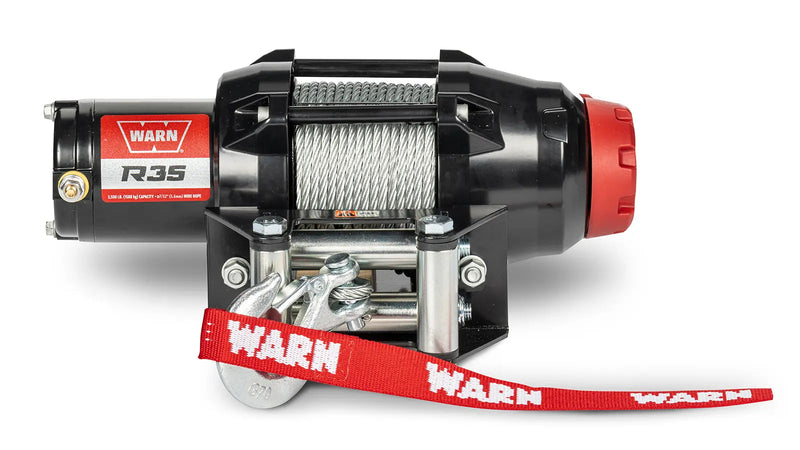
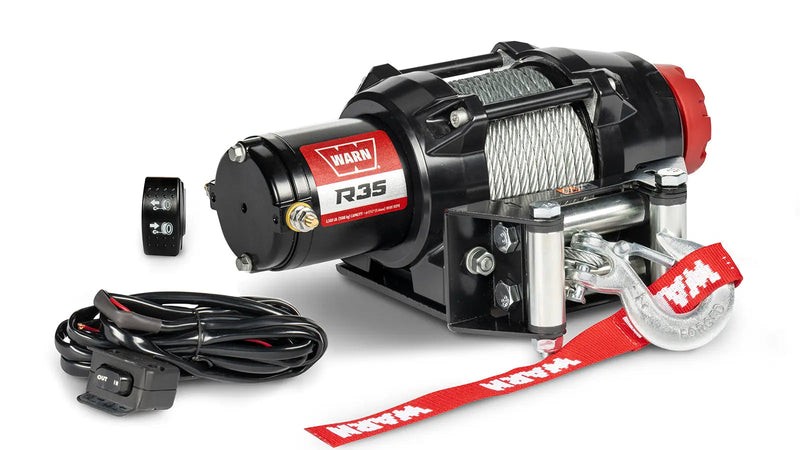
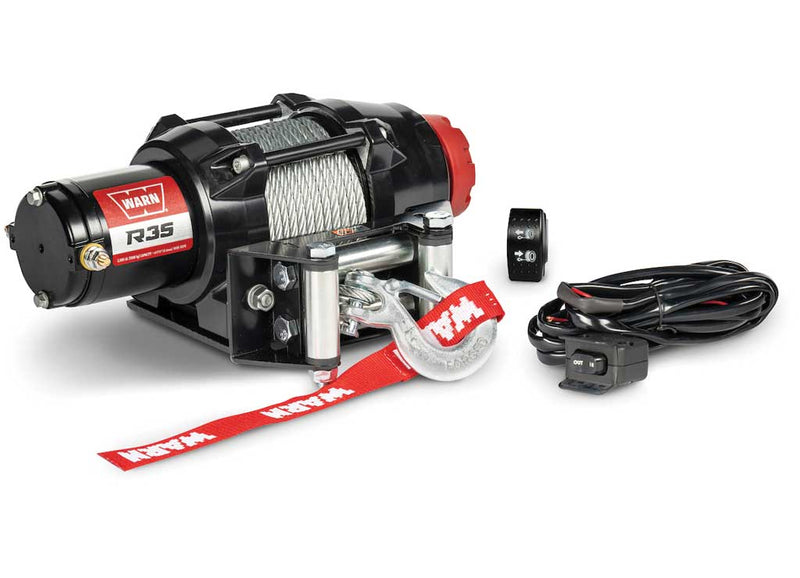
Warn R35 Powersports Winch, 3,500 lb, 50' 7/32" Steel Rope and Roller Fairlead (110035)


- No Sales TaxZero sales tax on every order
- 30-Day Money-Back GuaranteeReturn it within 30 days of delivery for a refund

Questions or a custom quote?
Mon to Fri, 9am to 5pm EST
Complete your upgrade
Fits the same truck
Features
- Steel wire rope, roller fairlead: The steel R-Series models wind 50' of wire rope through a roller fairlead: 3/16" on the R25, 7/32" on the R35 and 1/4" on the R45. Steel is the usual pick when the line will be dragged over rock, logs and gravel, and the rollers let it feed in when the pull comes from the side.
- All-metal three-stage planetary gears: Every R-Series winch drives its drum through a three-stage planetary gear train made entirely of metal. Warn names the all-metal gearing as one of the core R-Series features, next to IP67 sealing and the compact housing.
- IP67 sealing against water, dirt: Warn rates the R-Series IP67. On the IEC scale that means dust-tight and able to survive temporary immersion, so wet trails, splashes and a brief dunking at a crossing fall inside the rating. It is not the rating for a winch left sitting underwater for long.
- Automatic spring-type load brake: Let go of the switch and a spring-type brake engages by itself to hold the drum, so the load stays put instead of creeping back down the line. Warn fits this automatic load-holding brake to every R-Series model.
- Compact housing for tight mounts: Warn describes the R-Series as a compact design, a useful trait on machines where the winch has to tuck in behind a bumper or a mount plate. Warn gives full measurements for the R45 and R45-S: 14.6" long, 4.7" high and 4.6" wide.
- Engineered in Oregon, five-year warranty: Warn engineers the R-Series in-house at its Oregon headquarters, has it built to Warn specifications and runs it through Warn testing and quality checks. Coverage runs five years on the mechanical parts and three years on the electrical parts.
Description & Fitment
This is the R35, part 110035: a 3,500 lb winch with 50' of 7/32" wire rope on a roller fairlead. Like the R35-S, it is run from a handlebar-mounted rocker control switch. At 31.33 lb shipped, it weighs about 5 lb more than its synthetic-rope twin.
Fitment & Compatibility
Choose the right version: this is the steel-rope R35. With synthetic rope and a hawse fairlead: R35-S (110030). Less pull: R25 (110025). More pull: R45 (110045).
Not included: the vehicle-specific winch mount kit, sold separately.
About Warn
Warn Industries is a winch and recovery equipment maker headquartered in Clackamas, Oregon. Its range covers truck and SUV winches such as ZEON and the Heavyweight series, the AXON, VRX and R-Series powersports winches, the HUB Wireless Receiver and the portable Drill Winch.
The R-Series is Warn's standard-duty powersports line, rated from 2,500 lb to 6,000 lb, with steel wire rope or synthetic rope. Warn engineers it in-house at its Oregon headquarters and has it built to Warn specifications.
Buying Warn from Prestige Truck. Warn asks for proof of purchase, a dated sales receipt showing the Warn product, with any warranty claim, so keep your Prestige Truck order receipt with your records.
Frequently Asked Questions
What torque do the mounting bolts need?
Warn's manual gives 24.5 Nm (18 ft. lbs.) for class 8.8 metric (grade 5) or better bolts, and asks you to confirm bolt length for full thread engagement.
Which wiring diagram applies?
The 3500 diagram in Warn's manual, shared with the R35-S, with terminal nuts at 3.6-3.9 Nm (32-34.5 lb-in).
Do I need a separate winch mount?
Yes. Every R-Series winch bolts to a vehicle-specific winch mount kit, sold separately, made for your machine.
How many wraps must stay on the drum?
Warn says to keep at least 5 wraps of wire rope on the drum whenever you winch, since fewer wraps can let the rope slip loose. The synthetic-rope R-Series models need 10.
Can I ride through water with it?
Warn rates the R-Series IP67: dust-tight and sealed for temporary immersion, such as a creek crossing. It is not built to stay submerged. Warn's manual asks you to inspect the rope, hook and slings before every pull.
How long is the warranty?
Warn covers R-Series mechanical parts for five years and electrical parts for three. That is shorter than the lifetime mechanical term on Warn's VRX and AXON lines. Keep your order receipt and contact us to start a claim.
Installation
Here's the short version. Follow Warn's install sheet (below) for the exact positions and hardware.
- Read Warn's manual first, then choose a mounting spot strong enough for the winch's full rated pull, with the fairlead warning label facing up.
- Bolt the winch to the mount on the R25/R35 layout with class 8.8 metric (grade 5) or better hardware, checking bolt length against plate thickness, torqued to 24.5 Nm (18 ft. lbs.). Never weld the bolts, and finish the winch and hook before any wiring.
- Disconnect the vehicle battery cables, negative terminal first. Mount the handlebar switch clear of every vehicle control, confirming full handlebar travel before tying the cable down.
- Mount the contactor where its electrical terminals cannot touch metal, checking for fuel lines, the fuel tank, brake lines and wiring before you drill.
- Wire the equipment to the 3500 diagram, terminal nuts at 3.6-3.9 Nm (32-34.5 lb-in), with the supplied terminal boots fitted and cables kept off sharp edges, hot parts, battery terminals and moving parts.
- Before the first pull, follow Warn's check list: every fastener tight and at its torque, and wiring to every component verified correct.
Stuck on a step?
Specifications
| Brand | Warn |
|---|---|
| Part Number | 110035 |
| Line | R-Series powersports winch |
| Vehicle class | Powersports: ATV and UTV, per Warn |
| Voltage | 12V DC |
| Motor | Permanent magnet |
| Contactor | Separate contactor, mounted on its own |
| Gear train | All-metal three-stage planetary |
| Brake | Automatic load-holding, spring type |
| Clutch | Free spooling, clutch dial on the housing opposite the motor |
| Rope type | Wire rope |
| Fairlead | Roller fairlead |
| Rope length | 50' |
| Hook | Forged clevis hook with Warn hook strap |
| Waterproof rating | IP67 |
| Finish | Black powder coat |
| Mount type | Fixed mount on a vehicle-specific winch mount kit, sold separately |
| Mounting hardware | Class 8.8 metric (grade 5) or better, 24.5 Nm (18 ft. lbs.), per Warn |
| Design | Engineered in Oregon, built to Warn specifications |
| Model | R35 |
| Rated line pull | 3,500 lb (1,588 kg) single line, first layer |
| Rope | 50' of 7/32" (5.6mm) wire rope |
| Controls included | Handlebar-mounted rocker control switch |
| Shipping weight | 31.33 lb |
| Dimensions | 12.3" length, 4.7" maximum height, 4.6" maximum width |
| Mounting bolt pattern | 3" x 4.87", 4 holes |
| UPC | 012748119128 |
Warranty, shipping & returns
-
Warranty
Warn backs the mechanical parts of this R-Series winch for five years and the electrical parts for three years.- Warn supports the R-Series through its US-based customer service team.
- Keep your Prestige Truck order receipt as proof of purchase, and contact us to start a claim.
-
Free shipping
Ships free to the lower 48 states, with no minimum order.- Order by 5 PM ET on a business day and it starts processing the same day.
- Most orders arrive within 1-5 business days.
- We email your tracking number as soon as it ships.
-
Inspect on delivery
Check the carton for the winch with its rope, fairlead, clevis hook and hook strap, the contactor, the control switch and the wiring with its terminal hardware, then look over the rope and housing before you mount it. Check it as soon as it arrives.- Look for crushed ends, punctures or tears in the carton.
- If something looks wrong, take photos of the box and the parts (and if a driver asks you to sign, note the damage on the receipt).
- Open the box and check the parts against the parts list before you install.
- Email support@prestigetruck.com right away with your order number, a short note and photos. We send a replacement or a full refund at no cost to you.
-
30-day returns
Return it within 30 days of delivery, unused, in the original packaging, with proof of purchase.- Email support@prestigetruck.com with your order number. We reply within 1-2 business days with instructions.
- Damaged, defective or wrong item: we send a prepaid label or arrange a pickup.
- Changed your mind: you pay return shipping. No restocking fee.
- Refunds go back to your original payment method within 7 business days of approval. See our returns policy.